Building the core
As a Machine Learning engineer, I developed the core solution from modeling to production using Machine Learning and Deep Learning.
Operational AI · Professional experience
At Loopt, I worked on the core Machine Learning solution and later took on product management for the AI product. The challenge was to turn manual container allocation into a product used in daily operations.
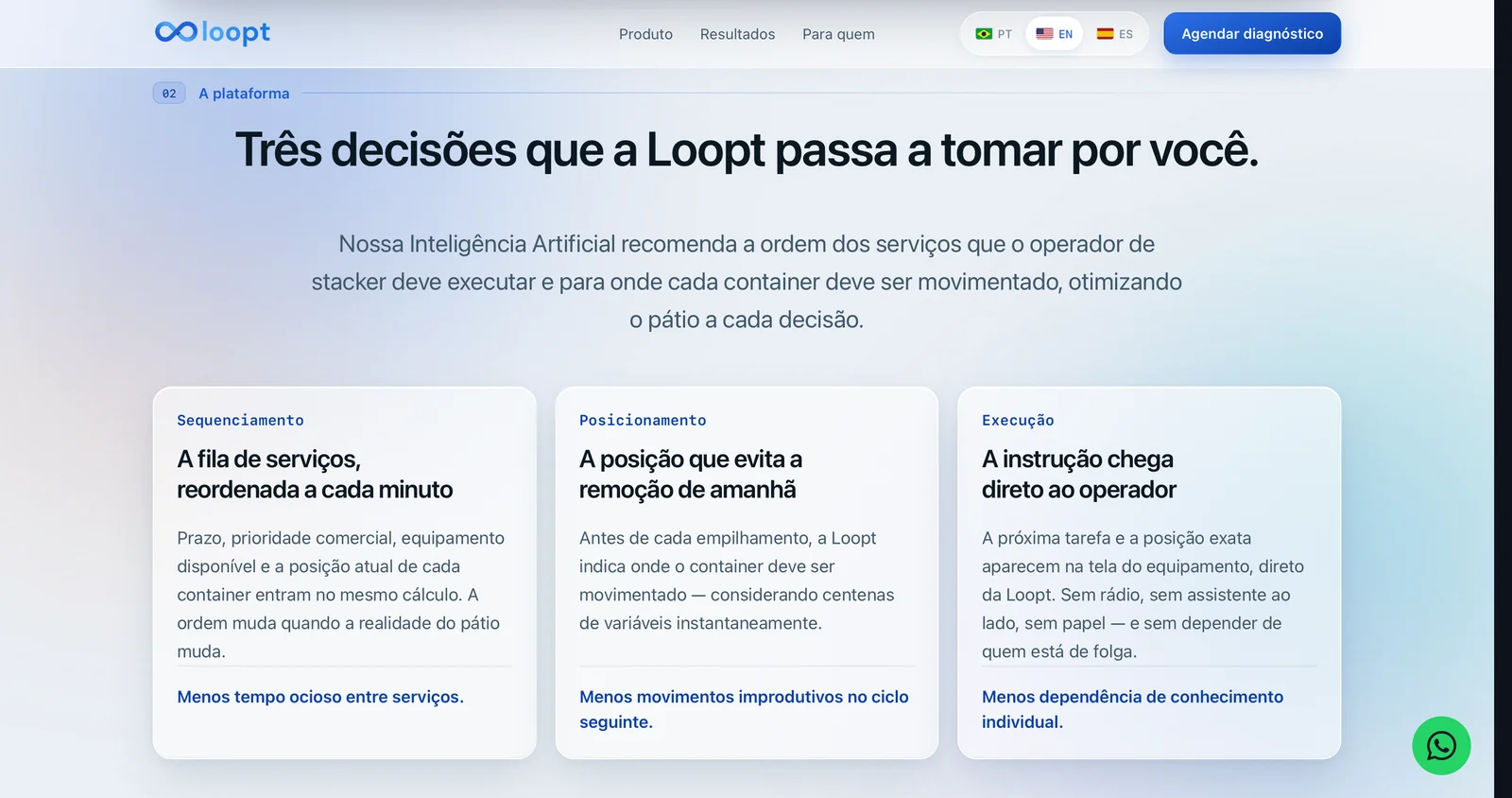
The product I worked on optimizes container allocation in the yard. A poor position can require extra moves when another unit needs to leave. The problem combines frequent decisions, operational constraints and scattered information.
My role brought together model development and the work of turning its output into a useful operational decision. Delivery needed to extend beyond modeling into everyday use.
My contribution
As a Machine Learning engineer, I developed the core solution from modeling to production using Machine Learning and Deep Learning.
I then took on the PM role, connecting operational needs, priorities and development with a cross-functional team.
I continued writing production code. This experience connects product decisions with their implementation and operational consequences.
Information from systems already used at the terminal.
The product evaluates conditions to recommend yard decisions.
Recommendations support positioning and execution.
A conceptual view based on the public product description, not a reproduction of internal architecture.
The outcome
According to Loopt in MundoLogística on January 13, 2026, the technology reduced unproductive moves by 27% and increased productivity by 21%.
Normalized indices: each indicator starts at 100.
100 → 73 represents a 27% reduction; 100 → 121 represents a 21% increase. These are not absolute counts or a time series.
Results of the solution developed by the team, according to the company. They do not measure my individual contribution in isolation.
An AI product needs to connect an operational problem, modeling and execution. My experience at Loopt covers those stages: first building the ML solution, then leading its evolution as a product.
My role is described from my professional history. This is experience predating the studio, not a Torno client engagement.
Case study prepared October 14, 2026.
Let’s understand the problem, the available data and how to verify a first delivery.